In this article
Quick Summary
If you want to sell comic books in New Jersey, Sparkle City Comics has been buying collections across the state since 1976. We buy everything from single Golden Age keys and CGC or CBCS graded books to original art, estates, and entire shop inventories. Evaluations are free, we travel throughout New Jersey for larger collections, and we pay immediately.
Looking to Sell a Comic Book Collection in New Jersey?
Whether you’re selling a single Golden Age key, a Silver Age Marvel run, CGC or CBCS graded comics, original comic artwork, an inherited estate, an original-owner collection, or an entire comic shop inventory, Sparkle City Comics has been buying comic book collections throughout New Jersey since 1976. If you’re ready to sell comic books in New Jersey, we make the process simple.
We’ve purchased everything from individual key issues to warehouses holding hundreds of thousands of comics, including original art bought directly from artists, untouched original-owner collections, complete comic shop inventories, dealer backstock, production artwork, and vintage toys.
Our office is just across the border in Middletown, New York, and New Jersey has always been one of our primary buying territories. We travel throughout North Jersey, Central Jersey, South Jersey, and the Jersey Shore, and many New Jersey collectors simply make the short drive to our office.
Whether your collection fills a short box, a room, a storage unit, a comic shop, or a warehouse, we’ll evaluate it, explain what you have, and help you get the most for it.
Free Comic Book Collection Evaluation
We can usually do an initial evaluation remotely before anyone loads boxes into a car or schedules an appointment.
Send a few photos or a short video, CGC or CBCS certification numbers, inventories, dealer box lists, estate paperwork, handwritten notes, or spreadsheets. Whatever you have, we’ll review it carefully.
We’ll explain what we’re seeing, answer your questions, and recommend the most practical next step.
For larger collections, original-owner collections, comic shop inventories, warehouse holdings, and estates, we’ll travel anywhere in New Jersey for an in-person evaluation.
There is never any obligation, pressure, or charge for an initial evaluation.
At a Glance
| Service | Details |
|---|---|
| Area Served | All of New Jersey |
| Travel Available | Yes |
| Remote Evaluations | Yes |
| Collections Purchased | Golden Age through Modern |
| Other Collectibles | Toys, Original Art, Statues, Trading Cards, Video Games, Pulps |
| Payment | Immediate |
| Experience | Buying Comic Collections Since 1976 |
Buying Comic Book Collections Throughout New Jersey Since 1976
We were buying collections long before online marketplaces, CGC grading, internet auctions, and digital price guides transformed the hobby, traveling the country one appointment at a time.
We’ve purchased collections in virtually every corner of New Jersey, including Bergen, Passaic, Morris, Essex, Hudson, Monmouth, Ocean, Mercer, Camden, Burlington, Sussex, Union, Middlesex, Somerset, Atlantic, and Cape May Counties.
Some purchases involved a handful of valuable comics; others required multiple trucks, specialized equipment, experienced crews, and days of planning. Sellers have included retired collectors, original owners, comic shops, artists, estates, dealers, and warehouses, and nearly five decades have taught us one lesson:
No two collections are ever exactly alike.
One collection holds a single extraordinary key issue; another fills a warehouse. Every one has its own story, and that still makes this business as exciting as it was in 1976.
Why New Jersey Has Produced Some of America’s Greatest Comic Book Collections
New Jersey’s dense population, long-established communities, and proximity to New York City created ideal conditions for generations of serious collectors.
From the Golden Age onward, millions of comics were sold through neighborhood newsstands, drug stores, department stores, grocery stores, and comic shops across the state. Many New Jersey collectors stayed in the same homes for decades, so comics bought in the 1950s, 1960s, and 1970s often stayed where they were first brought home, growing one issue at a time.
Collectors were also within easy reach of publishers, artists, conventions, dealer networks, and specialty shops throughout the Northeast. Weekend convention trips helped them complete difficult runs, find rare books, and buy original art directly from artists.
Those carefully preserved original-owner collections continue to surface through retirements, downsizing, estate settlements, and families helping collectors pass collections on.
Every phone call could uncover an untouched original-owner collection, a remarkable Golden or Silver Age discovery, or an exceptional piece of original comic art.
Original-Owner Comic Book Collections Throughout New Jersey
After nearly fifty years, one of our greatest privileges is still seeing collections exactly as they were assembled.
Original-owner collections were built by the people who bought the books at New Jersey newsstands, drug stores, department stores, comic shops, and conventions. Instead of passing through dealers and auctions, the books stayed together, growing month after month.
Opening one often feels like opening a time capsule. Complete runs remain as they were collected, and favorite characters are obvious immediately.
One collector may have every Spider-Man issue lined up; another focused on DC superheroes, EC horror, Warren magazines, underground comix, Marvel, or independent publishers. Others expanded into original comic art, animation art, production artwork, vintage toys, trading cards, statues, and movie memorabilia.
We’ve purchased New Jersey original-owner collections that sat untouched for forty or fifty years. Some occupied a few organized short boxes; others filled basements, spare bedrooms, garages, attics, storage units, commercial buildings, and entire homes. Some owners kept detailed handwritten inventories. Others could walk to a specific long box, pull a comic they hadn’t looked at in decades, and remember exactly where they bought it and what they paid.
The first thing we notice usually isn’t the key issues. It’s the consistency of the collection itself.
When an entire run shows the same handling, storage, and aging from beginning to end, it tells us the books have likely been together since they were purchased. That continuity is difficult, sometimes impossible, to recreate once a collection is broken apart.
Original ownership helps establish provenance, and complete runs provide historical context.
Old convention programs, receipts, correspondence, grading submissions, handwritten notes, photographs, and dealer invoices often show when and where books were bought and how the collection evolved. What looks like ordinary paperwork can significantly strengthen provenance.
We can’t remember every original-owner collection we’ve bought in New Jersey, but we remember the people: collectors who spent decades completing impossible runs, families who preserved comics through generations, retired collectors who never missed a monthly trip to their local shop, and the excitement of someone pulling out a favorite book and telling us where they found it forty or fifty years earlier.
Every original-owner collection represents years of enthusiasm, patience, friendships, convention trips, and Saturday visits to local comic shops. That’s why we approach each one with respect.
New Jersey’s Comic Book Collecting Legacy
Situated between New York City and Philadelphia, New Jersey had strong connections to two of the country’s most active comic markets.
Before online marketplaces and instant price comparisons, collectors mailed want lists to dealers, studied ads printed inside comic books, searched local shops one issue at a time, attended weekend conventions, traded with friends, bought from mail-order dealers, and sometimes waited years to complete a run.
Many collections we evaluate today come from that era, often with convention programs, receipts, correspondence, handwritten inventories, dealer catalogs, early price guides, grading paperwork, and photographs that preserve the history of both the collection and the hobby.
Collections of Every Size and Type
Not every important New Jersey comic book collection is enormous.
Some of our most valuable purchases consisted of only a few books. A single Golden Age key may be worth more than a room full of later comics, a small portfolio of original art may hold irreplaceable published pages, and a handful of unopened toys from the 1970s or 1980s can be an extraordinary find.
New Jersey has also produced some of the largest acquisitions in our company’s history.
We’ve evaluated single keys, complete Golden Age runs, original-owner Silver Age collections, Bronze and Copper Age accumulations, Modern Age variants, and registry-quality CGC and CBCS sets. We’ve also bought original art portfolios, artist and designer archives, retired dealer inventories, comic shop liquidations, unopened distributor stock, warehouses, estates, and mixed collections of toys, statues, trading cards, magazines, pulps, and video games.
Some purchases fit inside a briefcase. Others required tractor-trailers, pallets, crews, specialized equipment, and days of planning.
Size doesn’t determine value, and experience teaches you where the important material hides: a low-grade Golden Age comic mixed among inexpensive books, an untouched original-owner Marvel run, an unopened distributor case, or original production artwork the family assumed was old paper.
That’s why we ask sellers not to discard, separate, reorganize, clean, press, or grade anything before contacting us. Once a collection’s story is broken apart, it can rarely be reconstructed.
Over Fifty Years of New Jersey Discoveries
Our New Jersey acquisitions include an uninterrupted run of Action Comics #1–10 from a South Jersey collector, a warehouse holding more than 500,000 comic books, and original LJN Wrestling Superstars production artwork bought directly from its designer, along with countless original-owner collections, estates, dealer and comic shop inventories, and complete runs from every era.
Each required different expertise. Evaluating a Golden Age key is very different from buying an artist’s archive, authenticating production artwork, relocating a warehouse, or assessing a comic shop liquidation, which is why we never take a one-size-fits-all approach.
A South Jersey Collection We Never Expected to See
One phone call led us to one of the finest Golden Age Superman collections we’ve ever purchased: an uninterrupted run of Action Comics #1 through #10.
Finding ten consecutive issues, including the comic that introduced Superman, is something most buyers, dealers, and collectors never experience in an entire career.
The books showed the honest wear of more than eighty years, but they had three qualities collectors value tremendously: they were original, complete, and unrestored.
For a few moments, grading reports, price guides, transportation, negotiations, and insurance faded into the background. We simply appreciated what was in front of us.
Holding the first ten issues of the title that launched the superhero genre was a reminder that comic books are pieces of American cultural history.
Moments like that are why, after nearly fifty years, we still answer the phone and travel to collections.
Half a Million Comics Hidden Inside a New Jersey Warehouse
One of our largest acquisitions came from a New Jersey warehouse holding well over 500,000 comic books.
Walking in was almost overwhelming. Pallets stretched across the building, with unopened cartons, sealed distributor boxes, and factory cases stacked floor to ceiling, virtually untouched for decades.
The instinct is to start opening boxes. Experience teaches the opposite: step back, understand the scope, and plan before disturbing decades of organized inventory.
These weren’t picked-over overstock books. Much of the inventory remained exactly as shipped, and entire factory cases had never been opened.
Many dated to the height of the Todd McFarlane era and held complete unopened cases of the period’s most recognizable keys and bestsellers.
A project like this takes planning, logistics, staffing, transportation, organization, inventory management, and weeks of coordination.
The most remarkable part? It isn’t even the largest comic warehouse acquisition we’ve ever completed.
Comic Books Aren’t the Only Treasures We Find
A common misconception is that comic collectors only collected comic books. In nearly fifty years, we’ve found the opposite.
Lifelong collectors often expanded into original comic art, animation art, trading cards, vintage toys, production artwork, movie memorabilia, statues, pulps, video games, magazines, and advertising material.
One unforgettable New Jersey purchase came directly from the designer who created the production artwork for LJN’s WWF Wrestling Superstars toy line in the 1980s. We acquired the original artwork from the design process itself.
Pieces like these are one-of-one artifacts documenting how some of the era’s most recognizable toys came to life.
That’s why we ask sellers to tell us about everything in a collection: original art, vintage toys, animation art, production material, advertising displays, statues, trading cards, pulps, video games, and movie memorabilia. Sometimes the most important discoveries are the ones people never think to mention.
Selling Comic Book Collections Throughout New Jersey
New Jersey collections come in every size, condition, and format.
We’ve evaluated collections in historic homes, suburban basements, comic shops, warehouses, storage facilities, and estates. Some were meticulously cataloged; others sat untouched for decades exactly as the collector left them.
Neither presentation determines value. An organized collection may hold exceptional runs and high-grade books, while a disorganized group of boxes may hide an overlooked Golden Age key, a scarce variant, an original-owner Silver Age run, original art, or production material.
Our job is to understand what is actually there and evaluate it on historical significance, rarity, condition, and market demand, whether it’s twenty comics or twenty thousand.
What Types of Comic Collections Do We Buy?
We buy collections from every era, from a single key issue to warehouse holdings of hundreds of thousands of comics and related collectibles.
That includes Golden, Silver, Bronze, Copper, and Modern Age comics, CGC and CBCS graded books, original-owner collections, complete runs, original comic art, production artwork, comic shop inventories, dealer backstock, estates, convention inventory, warehouse holdings, and mixed collections with toys, statues, trading cards, magazines, pulps, video games, graphic novels, and trade paperbacks.
We regularly evaluate Marvel, DC, EC, Timely, Atlas, Dell, Gold Key, Harvey, Charlton, Warren, Image, Dark Horse, and independent publishers.
A collection doesn’t need famous keys to be valuable.
Complete runs, unusual publishers, consistently high grades, scarce variants, original ownership, provenance, production artwork, and related collectibles all add value. Some of our most rewarding purchases had no single headline book; they mattered because of their completeness, originality, and the story they told.
What Experienced Comic Buyers Notice First
An experienced buyer knows what to notice before a single comic leaves the box. Before evaluating individual issues, we evaluate the collection itself.
Storage consistency and matching aging across dozens or hundreds of books suggest a run has never been broken apart. Box, bag, board, and filing styles also show when and how a collection was assembled.
Old dealer markings, handwritten inventories, convention receipts, grading submissions, distributor labels, and purchase records often establish provenance that would otherwise be impossible to reconstruct.
We also check for humidity damage, brittle paper, storage odors, water exposure, insect activity, and subtle signs of restoration, which tell us how a collection has been preserved.
Sometimes the most important discovery is recognizing that an original-owner collection has stayed intact for decades. Once that history is scattered, it can never be recreated.
Golden Age Comics
Golden Age comics are among the most historically significant books in the hobby and one of our favorite categories to buy in New Jersey.
We buy from every major Golden Age publisher, including DC, Timely, EC, Fawcett, Fiction House, Quality, Fox Feature, MLJ, Dell, Harvey, and Atlas, across superheroes, Pre-Code horror, crime, westerns, war, science fiction, funny animals, and romance.
Many comics bought from New Jersey newsstands in the 1930s, 1940s, and 1950s stayed tucked away in family homes for generations. Some survived in remarkably high grade; others show decades of honest reading wear. Both can be highly collectible.
Our South Jersey Action Comics #1–10 run showed decades of use, but it was complete, unrestored, and historically significant, qualities experienced collectors often value more than cosmetic imperfections.
Never assume an older comic has little value because it isn’t perfect. Scarcity, completeness, restoration status, historical importance, provenance, and desirability often matter as much as grade.
Silver Age Comics
The Silver Age introduced many characters that still define comics, making it one of the strongest segments of the market.
We regularly buy landmark Marvel and DC keys, including first appearances of Spider-Man, the Fantastic Four, the Hulk, the X-Men, the Avengers, Thor, Iron Man, Doctor Strange, Green Lantern, and the Justice League, plus original-owner collections and uninterrupted runs that have stayed together for decades.
Many New Jersey collectors started buying during Marvel’s early years and never stopped. Their collections often include complete runs, annuals, crossovers, giant-size issues, and convention purchases.
An intact Silver Age collection also tells us about storage, handling, collecting habits, and provenance, which can significantly influence value. Some of our favorite purchases had no headline key at all, just decades of thoughtful collecting and consistent preservation.
Bronze Age Comics
The Bronze Age remains one of the healthiest and most widely collected periods in the market.
During the 1970s and early 1980s, horror returned to mainstream comics, antiheroes gained popularity, independent publishers flourished, specialty comic shops spread, and conventions grew in importance.
We buy every corner of the Bronze Age: Marvel and DC keys, horror, underground comix, magazine-format comics, independents, complete runs, Mark Jewelers variants, newsstand editions, and original-owner collections, across superheroes, horror, science fiction, war, and fantasy.
Many New Jersey collectors carried their Silver Age runs straight through the Bronze Age, often including annuals, giant-size issues, limited series, and crossover events.
Bronze Age books often look well cared for, but manufacturing defects, page quality, staple placement, handling, storage conditions, and restoration all affect value.
Copper Age and Modern Comic Books
Modern value depends on a shifting market: print runs, retailer incentive variants, newsstand editions, cover artists, first appearances, grading potential, and current demand. An ordinary-looking collection may hold scarce variants, low-distribution independents, complete runs, or overlooked modern keys.
We buy Marvel, DC, Image, Dark Horse, Boom! Studios, IDW, Dynamite, and independent collections, from a few short boxes to entire comic shop inventories and warehouses, including creator-owned books, horror, and modern variants.
In our 500,000-comic New Jersey warehouse purchase, the value wasn’t the quantity. It was knowing which unopened cases held issues collectors still pursue decades later.
That judgment comes from years of buying collections, following market trends, and understanding print history.
CGC and CBCS Graded Comic Books
We have extensive experience buying certified collections, from a single key to registry-quality sets of hundreds of books.
We buy CGC and CBCS comics from every era, including Universal, Signature Series, Qualified, Restored, Conserved, and pedigree books, from Golden Age keys and Silver Age classics to high-grade Bronze Age, Copper Age highlights, and modern CGC 9.8 collections.
Evaluating a graded comic involves much more than the number on the label.
We also consider page quality, eye appeal, restoration or conservation, census population, pedigree, grader’s notes, signature authenticity, case condition, pressing history when known, market demand, and recent comparable sales.
Two comics with identical grades can sell for dramatically different prices. Grading provides information; experience determines how to interpret it.
Original Comic Art
Original comic art is one of the most competitive and historically significant areas of the hobby.
Unlike a printed comic, every published piece is unique: one original cover, one splash page, one interior page used to produce the comic readers held.
There’s no warehouse of extra copies, so originality, authenticity, provenance, and condition are especially important.
For more than fifty years, we’ve bought original art from collectors, artists, estates, dealers, and comic shops throughout New Jersey and the Northeast.
We buy published covers, splash pages, interior pages, commissions, convention sketches, production artwork, color guides, cover proofs, animation art, newspaper strips, editorial illustrations, complete artist archives, and original toy and merchandise artwork.
New Jersey has long been one of the strongest original art markets. Proximity to New York City gave collectors access to artists, publishers, conventions, dealers, galleries, and early art-trading networks, and many began buying in the 1970s and 1980s, long before pages were seen as major collectibles. Art bought directly from creators then, especially with documentation or correspondence, is now among the most desirable material in the hobby.
How Original Comic Art Is Evaluated
No standard price guide can fully value a one-of-a-kind piece.
We consider the artist, characters, publication, story significance, visual impact, historical importance, condition, provenance, originality, production elements, alterations, comparable sales, and collector demand. No single factor decides value.
A cover featuring a major character may command a premium over an interior page from the same issue, yet a historically important splash page may beat a lesser cover. A visually dramatic page may outsell another by the same artist, and an early appearance or landmark storyline page may be valued very differently from one of similar artistic quality.
Provenance matters just as much. Art acquired directly from an artist, publisher, designer, or original owner often comes with receipts, notes, convention programs, correspondence, photographs, or certificates that establish a clear chain of ownership.
Never discard that documentation. It can be as important to the artwork’s history as the art itself.
Original LJN Wrestling Merchandise Art From the 1980s
One of our most memorable New Jersey art acquisitions was original merchandise artwork for LJN’s WWF Wrestling Superstars toy line, purchased directly from the designer who helped bring it to life.
Anyone who grew up in the 1980s remembers those oversized rubber wrestling figures, with their colorful packaging and bold character designs.
Before a figure reached store shelves, designers, illustrators, product developers, licensors, photographers, packaging specialists, and manufacturers produced production artwork, concept designs, packaging layouts, color guides, and presentation materials.
That artwork documents how the product was created, preserves the visual development of characters who became cultural icons, and captures creative decisions never meant for public display.
Buying it directly from the designer also gave it what collectors value most: provenance. The art never left the person who helped create it.
Never assume old production material, sketches, packaging designs, color guides, transparencies, presentation boards, or mock-ups are obsolete work files. In the right context, they’re important pieces of entertainment history.
Production Art, Color Guides, and Cover Proofs
Some of the most fascinating collectibles are production materials that show how comics, toys, animation, packaging, and licensed merchandise were made.
We evaluate hand-colored guides, printer proofs, cover proofs, logo designs, mechanical paste-ups, photostats, packaging artwork, advertising illustrations, character designs, model sheets, animation cels, promotional artwork, and complete publisher archives.
Many were never meant to survive. Publishers, printers, animation studios, and manufacturers treated them as temporary working documents, discarding, reusing, or losing them once a book was printed or a product shipped, so surviving examples are surprisingly scarce.
Their value depends on the property, creator, production process, provenance, condition, historical significance, and demand. A production piece matters for what it represents, not just how it looks.
Estate Comic Book Collections in New Jersey
Family members often inherit thousands of comics, original art, toys, statues, or trading cards they never collected. They know the collection mattered to their loved one but have no practical way to judge its value or how to sell it.
We explain what the collection contains, identify significant material, answer questions honestly, and give a fair evaluation without pressure or obligation. Families never need to organize, grade, catalog, or research anything first; we recommend leaving it exactly as it is.
How books were stored, labeled, and preserved, along with receipts, handwritten inventories, correspondence, convention programs, and grading records, often tells us as much as the comics themselves and helps establish provenance.
Whether an estate holds one short box or a lifetime of collecting, we handle it with patience and respect for the family preserving a loved one’s legacy.
You Do Not Need to Organize an Inherited Collection
Families often assume dozens or hundreds of boxes must be alphabetized, cataloged, researched, or priced before anyone can evaluate them. In most cases, that isn’t necessary.
Please leave the collection as close to its original state as possible.
A box labeled with a publisher, title, year, convention, or handwritten notes may reveal how the collection was assembled.
Keep receipts, inventories, correspondence, grading submissions, auction records, notes, and photographs; they help establish provenance.
Original art, toys, magazines, production material, trading cards, and statues stored with the comics may be part of the larger story, and separating them too quickly removes context.
There’s no need to remove every comic from its bag or inspect every page. Improper handling can damage fragile Golden Age books, high-grade comics, brittle paper, original art, and older magazines.
Improper handling can cause avoidable damage, particularly with fragile Golden Age books, high-grade comics, brittle paper, original comic artwork, and older magazines.
We’ll identify what deserves attention and explain what you’ve inherited before any decisions are made.
Respectful Estate Evaluations
Estate evaluations often happen during an emotional, complicated time.
Families may be managing probate, preparing a home for sale, coordinating with attorneys and executors, traveling between states, and meeting deadlines while trying to understand a collection they know little about.
We explain what we’re seeing, identify significant material, discuss the options, and make a straightforward, no-obligation offer when appropriate. Families should understand what they have before making any decisions.
For larger collections, we can handle the entire removal after a purchase: packing supplies, boxes, protective materials, personnel, vehicles, pallets, loading, transportation, and coordination with estate representatives, attorneys, executors, property managers, or family members.
Families should never have to move thousands of comics just to learn what they’re worth. An on-site evaluation preserves context, reduces handling, and lets us advise you before anything is packed or moved.
Comic Shop Inventories and Dealer Collections
New Jersey has supported an active comic shop and dealer community for decades.
Many stores opened during the direct-market growth of the 1970s, 1980s, and 1990s. Some lasted generations; others closed with backstock, convention inventory, customer collections, unopened distributor product, fixtures, supplies, and warehouse material still in place.
Buying a shop inventory differs from buying a private collection.
It may include back issues, new releases, distributor stock, supplies, statues, toys, games, graphic novels, magazines, showcases, fixtures, shelving, and point-of-sale equipment spread across several rooms or locations. Evaluating it requires understanding retail operations, logistics, and transportation, not just collectible value.
We’ve bought complete comic shops, dealer inventories, warehouses, and business liquidations throughout New Jersey and the Northeast.
Some acquisitions take a single day. Others require multiple trucks, palletizing equipment, loading crews, forklifts, and coordinated transportation, so we tailor each plan to the inventory.
Whether you’re retiring, downsizing, closing a shop, or liquidating warehouse inventory, we’ll discuss the most practical purchasing solution.
Warehouse Collections and Large Accumulations
Few buyers can purchase, pack, and transport truly massive collections. A warehouse holding hundreds of thousands of comics requires operational experience as much as comic knowledge.
Warehouses may contain unopened distributor cases, dealer backstock, publisher overstock, retail inventory, supplies, and promotional material, often mixed from multiple acquisitions, closed shops, and long-term storage.
Buying one requires logistics, transportation, staffing, organization, inventory management, planning, and experience.
Our 500,000-comic New Jersey warehouse purchase required careful planning long before the first box was loaded, from evaluating inventory and coordinating equipment to organizing crews and transportation.
You can’t value a holding like this by multiplying the number of comics by an average price. Some cases hold highly desirable material, others heavy duplication of common books, and condition varies with how cartons were stacked, moisture exposure, temperature and humidity swings, and warehouse upkeep.
Our experience with shop liquidations, warehouse discoveries, and high-volume acquisitions lets us value the material accurately and plan its safe, efficient removal.
One Buyer for Comics, Art, Toys, and More
We can buy an entire collection rather than cherry-picking the easiest or most valuable pieces.
Many collections also include original art, toys, statues, trading cards, magazines, video games, production material, animation art, and memorabilia, often reflecting one collector’s lifelong interests.
Instead of finding a different specialist for each category, Sparkle City Comics and our sister company, Neat Stuff Collectibles, can often buy everything in one transaction: one appointment, one evaluation, one offer, one payment, and one coordinated pickup.
That’s especially valuable for estates, retiring collectors, shop liquidations, artist archives, warehouses, dealer inventories, and large mixed collections.
Our LJN WWF Wrestling Superstars artwork purchase shows why. A comics-only buyer might have overlooked it, and a general antiques buyer might not have recognized its importance to toy collecting and licensed entertainment history.
Vintage Toys and Action Figures
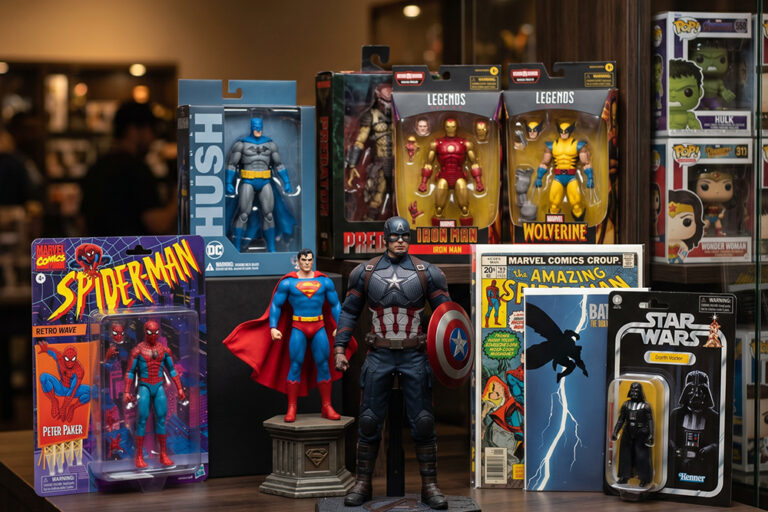
Vintage toys are among the most common categories we find alongside comics. Many collectors expanded into action figures, vehicles, playsets, and licensed merchandise during the 1970s, 1980s, and 1990s.
We buy Mego, Kenner, Hasbro, Mattel, LJN, Marx, Ideal, Remco, Toy Biz, McFarlane Toys, Bandai, Takara, Playmates, Galoob, and more, including loose figures, carded examples, factory-sealed cases, vehicles, prototypes, store displays, foreign releases, original packaging artwork, and dealer inventories.
Rarity, completeness, packaging, manufacturer, character, and provenance matter alongside condition. An incomplete childhood toy can still be collectible.
Some of the most significant pieces were never sold at all. A prototype, production sample, packaging mock-up, or original artwork from a well-known toy line may be unique.
Comic Statues and High-End Collectibles
We buy limited-edition statues from Bowen Designs, Sideshow Collectibles, Prime 1 Studio, XM Studios, Iron Studios, Kotobukiya, Gentle Giant, DC Direct, Hot Toys, PCS Collectibles, Tweeterhead, and others.
Collections range from one display piece to hundreds of boxed statues. We consider manufacturer, edition size, artist, condition, completeness, original packaging, shipping cartons, certificates, repairs, provenance, and demand.
Original packaging can significantly affect value, especially for large or fragile pieces, but many rare statues remain highly collectible without their boxes.
Fragile components, oversized boxes, weight, limited access, and high replacement costs require careful planning, and we transport every piece safely.
Magazines, Pulps, and Vintage Paper
Many comic collectors also collected magazines, pulps, and other vintage paper spanning horror, science fiction, fantasy, film, and adventure.
We actively purchase:
- Creepy
- Eerie
- Vampirella
- Famous Monsters of Filmland
- Savage Sword of Conan
- Heavy Metal
- Epic Illustrated
- Marvel magazines
- Warren Publishing
- Underground magazines
- Fanzines
- Science-fiction pulps
- Hero pulps
- Detective magazines
- Horror magazines
- Men’s adventure magazines
- Movie magazines
- Vintage catalogs
- Comic-related promotional material
Magazines were often stored without bags or boards, oversized formats were harder to preserve, and inserts, posters, centerfolds, subscription labels, and mailing materials all affect value. Complete examples are often scarcer than collectors expect.
Pulps are especially fragile. Their acidic paper was never meant to last, so well-preserved examples are increasingly uncommon.
Scarcity often matters as much as condition. Uncommon titles, important cover artists and illustrators, first appearances, significant stories, publisher variations, and short-lived publications draw the most interest.
Trading Cards, Video Games, and Gaming Collectibles
Mixed collections often include trading cards, video games, and tabletop gaming alongside comics.
We buy Magic: The Gathering, Pokémon, non-sport cards, vintage wax boxes, sealed products, Nintendo and Sega games, PlayStation and Xbox titles, factory-sealed video games, Warhammer, board games, miniatures, role-playing games, and gaming accessories.
Keep these collections intact until they’re evaluated. A common-looking box may hold an important set, scarce variant, rare promo, sealed product, or out-of-print game.
Our Buying Process
Our process keeps selling simple and transparent, from first call to final pickup.
Step 1 — Contact Us
Reach out by phone, email, or our online contact form. Photos, videos, inventories, or a brief description are often enough for initial guidance.
Step 2 — Initial Review
We’ll review what you’ve sent, answer your questions, and decide whether an in-person evaluation makes sense. Often we can offer useful insight before visiting.
Step 3 — Collection Evaluation
For qualifying collections, we’ll travel anywhere in New Jersey. We’ll identify important comics, original art, and other collectibles and discuss the collection as a whole, not just its highlights.
Step 4 — Fair Offer
We’ll present a straightforward cash offer for the collection as a whole, explain how we arrived at it, and give you time to decide. There is never any obligation to sell.
Step 5 — Immediate Payment & Removal
If you accept, payment is immediate and we pack, load, and remove the collection ourselves. No shipping, movers, or logistics for you, whether it’s a single room, an estate, a comic shop, or a warehouse.
Choosing the Right Comic Book Buyer
You can sell to comic shops, auction houses, private buyers, online marketplaces, or consignment companies. Each has advantages depending on the collection and your goals.
The better question isn’t “Who pays the most?” It’s “Who is best equipped to evaluate my collection correctly?”
A modern-comics buyer may not recognize the significance of original art, production material, or publisher archives.
A Golden Age specialist may have little experience with warehouses, shop liquidations, or large dealer collections.
A general antiques buyer may overlook cover proofs, prototype toys, animation art, comic statues, or complete publisher runs.
The right buyer understands the entire collection and how comics, art, production material, toys, statues, magazines, cards, and games relate, along with provenance, condition, and demand.
Selling Your Collection Yourself vs. Working With an Experienced Buyer
Selling one book at a time can maximize prices for individual items, particularly exceptionally rare or high-demand books.
It also means photographing, researching, grading, listing, answering questions, negotiating, processing payments, packing, shipping, handling returns and claims, and paying marketplace fees. A large collection can become months or years of work.
Working with an experienced buyer means one evaluation, one offer, one payment, and one pickup, with no individual listings or hundreds of separate transactions.
Neither option is right for everyone. Some collectors enjoy selling themselves; others value convenience and immediate payment. We’re happy to discuss both.
What Determines the Value of a Comic Book Collection?
The question we hear most is, “How much is my comic book collection worth?”
No two collections are alike. Two with many of the same titles can differ dramatically in value based on condition, completeness, provenance, scarcity, and preservation. We evaluate the collection as a whole, not just the age of the books.
| Category | Examples |
|---|---|
| Golden Age | First appearances, pre-Code horror, scarce publishers, iconic covers |
| Silver Age | Marvel keys, DC keys, complete runs, landmark issues |
| Bronze Age | Wolverine, Punisher, Moon Knight, Ghost Rider, Swamp Thing, Star Wars |
| Modern Comics | Variants, low-print books, independent publishers, 9.8 candidates |
| Original Owner Collections | Complete runs, consistent preservation, provenance |
| Original Comic Art | Covers, splash pages, interiors, commissions, production artwork |
| Dealer Inventory | Warehouse holdings, backstock, unopened cases |
| Toys & Collectibles | Vintage toys, statues, games, trading cards, production material |
Beyond the type of material, we evaluate:
- Condition
- Page quality
- Completeness
- Restoration
- Conservation
- Provenance
- Signatures
- Pedigrees
- Market demand
- Comparable sales
- Scarcity
- Publisher
- Historical importance
Sometimes the greatest value isn’t a single comic. It may be:
- A complete original-owner collection or uninterrupted title run.
- A portfolio of original comic artwork.
- An unopened distributor case.
- A warehouse holding or dealer inventory.
- A designer archive or publisher archive.
- Vintage toy production material or original packaging artwork.
- A collectible the owner never realized had become valuable.
That’s why we ask sellers not to separate collections before contacting us. Organization, documentation, and the relationships between parts of a collection provide context that can’t be recreated once everything is divided.
Why Collectors Throughout New Jersey Choose Sparkle City Comics
Since 1976, we’ve purchased everything from single key issues to some of the largest acquisitions in our history: original-owner collections, warehouses, comic shop inventories, original art, artist archives, production material, estates, vintage toys, and large mixed collections.
Whether it’s a handful of comics, a full comic shop, an estate, or a warehouse, our commitment is the same: honest evaluations, recognizing the full significance of every collection, and a straightforward, transparent, respectful process.
Every collection represents years, often decades, of passion. Our responsibility is to understand that story before placing a value on it.
We Buy Comic Collections Throughout North Jersey
North Jersey has produced some of the most impressive comic, vintage toy, original art, and pop-culture collections we’ve encountered.
Its density, established neighborhoods, and proximity to New York City gave collectors access to newsstands, independent comic shops, bookstores, flea markets, antique markets, conventions, artist appearances, publisher employees, and the extensive New York City dealer network.
Many collectors started as children and kept going for decades; others came in during the direct-market boom through conventions, original art, vintage toys, sports and non-sport cards, role-playing games, and local hobby shops.
We buy throughout Bergen, Passaic, Essex, Hudson, Morris, Sussex, Warren, and Union Counties, including Hackensack, Paramus, Ridgewood, Fort Lee, Englewood, Teaneck, Paterson, Wayne, Clifton, Montclair, Newark, Livingston, West Orange, Jersey City, Hoboken, Morristown, Parsippany, Dover, Newton, Sparta, Summit, Westfield, Elizabeth, and surrounding towns and rural properties.
North Jersey collections turn up in city apartments, suburban homes, estates, storage facilities, former retail spaces, comic shops, warehouses, and office buildings, and can be spread across basements, garages, attics, off-site units, and multiple properties.
North Jersey’s Connection to the Comic-Book Industry
For decades, publishers, editors, artists, printers, distributors, and licensing companies operated near North Jersey, giving local collectors unusual access to conventions, creators, and original art.
As a result, North Jersey collections often include original art, color guides, cover proofs, publisher correspondence, convention material, licensing artwork, promotional items, dealer catalogs, artist sketches, photostats, and complete personal archives.
Much of this was working material for artists, editors, designers, printers, and licensors and was discarded after publication, so surviving examples can be remarkably scarce. Families sometimes mistake them for ordinary office paperwork or printer’s proofs.
We Buy Comic Collections Throughout Central Jersey
Stable neighborhoods, long-term home ownership, and access to both New York City and Philadelphia let many Central Jersey collections stay undisturbed for generations.
Many are original-owner collections still in the home where they were built, some meticulously organized over forty or fifty years, others untouched in basements, closets, attics, or spare bedrooms since the owner stopped collecting.
We buy throughout Middlesex, Mercer, Somerset, Hunterdon, and parts of Monmouth and Union Counties, including Edison, Woodbridge, New Brunswick, East Brunswick, Piscataway, Metuchen, Princeton, Trenton, Hamilton, Lawrenceville, Hopewell, Somerset, Bridgewater, Hillsborough, Somerville, Flemington, Clinton, Freehold, Marlboro, Manalapan, and surrounding farms, estates, and small towns.
We regularly find original-owner Silver Age collections, complete Marvel and DC runs, Bronze Age horror, Copper Age dealer stock, Modern high-grade collections, CGC Registry Sets, original art, shop inventories, toys, statues, cards, video games, and multi-generation family estates. Ample suburban storage means many hold more history, and value, than their owners realize.
We Buy Comic Collections Along the Jersey Shore
The Jersey Shore has produced a surprising number of remarkable collections, some assembled by year-round residents who used local comic shops, boardwalk retailers, conventions, and hobby stores.
We buy throughout Monmouth and Ocean Counties and farther south, including Long Branch, Red Bank, Asbury Park, Middletown, Holmdel, Freehold, Point Pleasant, Brick, Toms River, Lakewood, Jackson, Seaside Heights, Barnegat, Manahawkin, Long Beach Island, Atlantic City, Ocean City, Wildwood, and Cape May.
Shore collections turn up in year-round homes, beach houses, seasonal properties, storage units, former retail locations, comic shops, warehouses, and long-held family estates.
Some favorite discoveries came from family vacation homes. Children read comics on summer trips, left them at the shore, and added more each year until modest vacation piles became multi-generation collections.
Humidity, salt air, flooding, and seasonal temperature swings affect paper differently than inland, so an in-person evaluation helps us assess how the environment affected each item.
Boardwalk and resort towns also supported arcades, toy stores, gift shops, card shops, comic retailers, amusement businesses, and seasonal dealers. When they closed, inventory often went into storage, and we’ve found vintage comics, cards, arcade items, toys, posters, promotional displays, video games, sealed cases, and store stock untouched for years.
We Buy Comic Collections Throughout South Jersey
South Jersey gave us some of our most unforgettable acquisitions, including the uninterrupted Action Comics #1–10 run.
Older communities, rural properties, long-held family homes, and proximity to Philadelphia have preserved collections for generations in basements, attics, spare rooms, barns, garages, and outbuildings.
We buy throughout Burlington, Camden, Gloucester, Salem, Cumberland, Atlantic, and Cape May Counties, including Cherry Hill, Moorestown, Mount Laurel, Burlington, Medford, Voorhees, Haddonfield, Collingswood, Camden, Deptford, Glassboro, Woodbury, Mullica Hill, Vineland, Millville, Bridgeton, Salem, Hammonton, Egg Harbor Township, Atlantic City, Ocean City, Wildwood, Cape May, and surrounding farms and small towns.
Many South Jersey collectors crossed the Delaware River to Philadelphia’s comic shops, conventions, department stores, and collector networks to find missing issues and meet creators. Others bought locally and preserved their childhood collections at home, often producing remarkably complete runs alongside original art, toys, and other collectibles.
Rural Properties, Barns, Garages, and Outbuildings
Some of our largest and most unusual New Jersey collections came from rural properties, barns, garages, workshops, commercial buildings, basements, and attics, not climate-controlled comic rooms.
These collections may have faced moisture, rodents, insects, dust, mold, temperature changes, collapsed boxes, improper stacking, or difficult access.
Difficult conditions don’t mean a collection is lost. Exterior boxes often absorb the worst while the contents survive. Sealed cases outlast loose comics, plastic totes protect toys, cards, and games, and filing cabinets or flat files sometimes hold original art, production material, publisher archives, or correspondence.
Don’t throw anything away based on how the storage area or outer boxes look. An experienced buyer can tell what remains collectible, what needs specialized handling, and what deserves conservation or professional grading.
New Jersey Estate Attorneys, Executors, and Fiduciaries
We regularly work with New Jersey estate attorneys, executors, trustees, fiduciaries, and financial professionals who need help evaluating and purchasing comic collections during estate administration.
Comic collections can be hard to inventory, spread across properties, poorly labeled, uninsured, stored off-site, mixed with personal belongings, disputed among heirs, or simply unfamiliar to the professionals involved.
We provide evaluations and purchase offers for comics, original art, vintage toys, statues, trading cards, video games, magazines, pulps, dealer inventory, production artwork, and mixed collections, with minimal disruption to the estate.
We coordinate directly with the estate representative, attorney, property manager, trust officer, or designated family member and can provide a detailed written offer, handle packing and removal, and work within the estate’s timeline, with documentation, confidentiality, and clear communication throughout.
Insurance, Divorce, and Collection Valuation Situations
Not every evaluation begins with a sale. Collectors, families, attorneys, executors, trustees, insurance professionals, and financial advisors also need guidance after a death, divorce, insurance loss, water or fire damage, theft, relocation, business closure, partnership dissolution, or financial restructuring.
The purpose sets the approach. A sale reflects realistic current demand, condition, and the cost of converting a collection to cash. An insurance claim may need replacement-value documentation, and a fire- or water-damaged collection may need item-by-item review. In a divorce or legal matter, a neutral explanation of condition, restoration, grading, liquidity, demand, and selling costs helps all parties.
Retail asking price, auction estimate, replacement value, fair market value, dealer purchase value, net proceeds after fees, and immediate liquidation value are different figures for different purposes. Confusing them creates unrealistic expectations and disputes, so we explain why methods produce different results.
Should You Sell Your Comics to a Local Comic Shop?
A local comic shop can be a good option for a smaller collection, especially if it specializes in what you own.
But not every shop has the capital, space, or logistics for major Golden Age keys, large original-owner collections, original art, warehouses, store liquidations, high-end CGC collections, toy archives, statues, production artwork, or collections needing freight and multiple crews.
Shops have finite display space, budgets, staff, and cash flow, so they focus on material they can sell quickly. That reflects a retail business model, not dishonesty.
Before accepting any offer, ask:
- Does the buyer regularly purchase collections of this size?
- Do they understand every category represented, including comic books, original artwork, toys, statues, trading cards, video games, and other collectibles?
- Can they pay immediately?
- Can they handle all packing, transportation, and removal?
- Are they properly insured?
- Can they provide references from previous purchases?
- Do they have experience working with estates, executors, attorneys, and fiduciaries?
- Will they purchase the entire collection, or only select the most valuable items?
Those answers matter far more than whether the buyer is nearby.
Should You Use a Comic Auction House?
An auction house can be excellent for an important Golden Age key, an exceptional original art cover, a rare production piece, or an elite CGC comic that will draw worldwide bidding.
Consignments can involve seller commissions, buyer’s premiums, photography and grading fees, shipping, insurance, payment delays, unsold lots, reserve decisions, market timing, and uncertain results.
An auction estimate isn’t a guaranteed price, and the published headline result isn’t what the consignor receives after fees and costs.
For large mixed collections, many auction houses take only the top material, leaving the family with the lower-value comics, runs, toys, magazines, and cards to sell elsewhere.
Selling directly means you know the exact price before accepting, payment is immediate, and there’s no uncertainty about whether material will sell.
Neither approach is always better. Auction may maximize a few exceptional items; a direct purchase of the whole collection is often more practical and predictable.
Should You Accept a Consignment Offer?
Consignment can suit sellers who want someone else to manage sales and can wait. It may return more than an immediate sale, but weigh that against added time, costs, and uncertainty.
Before signing, review the commission, term, insurance responsibility, pricing and discount authority, return rights, payment timing, unsold inventory procedures, termination provisions, grading expenses, and photography or listing fees.
Know when you’ll be paid (per item, monthly, quarterly, or only after everything sells) and who bears the risk if material is damaged, lost, returned, or disputed.
With a direct purchase, payment is immediate once we agree on a price, and the transaction is complete.
The right choice depends on your goals, timeline, and willingness to trade certainty for a possibly higher return.
Warning Signs When Choosing a Comic Buyer
Most comic buyers are honest, but always know who you’re dealing with before completing a sale.
Be cautious if a buyer won’t give a business name, has no verifiable history, pressures you to decide immediately, won’t explain the offer, wants to remove material before payment, asks you to ship valuable comics or art without documentation, avoids discussing insurance, makes an unusually large offer from a few blurry photos, or sharply lowers the offer on arrival without a legitimate reason.
Also watch for buyers who focus only on obvious keys, call everything else worthless without reviewing it, won’t provide a receipt or bill of sale, can’t explain how payment works, or insist on separating art or rare books before an agreement.
Before selling, know who is buying, which company they represent, how long they’ve been in business, how payment will be made, who handles packing and removal, exactly what’s included, and whether they’re insured.
Trust your instincts, and rely on clear communication and documented agreements.
Frequently Asked Questions About Selling a Comic Collection in New Jersey
How do I know if my comic book collection is valuable?
Most people who contact us don’t know. Some think every old comic is worth a fortune; others assume read childhood copies are worthless. The truth is usually in between.
Value depends on age, condition, rarity, publisher, first appearances, complete runs, original ownership, grading, original art, and demand. Sometimes one comic holds most of the value; sometimes complete runs and consistent condition make the collection. An experienced evaluation is the only reliable answer.
Do I need to make an appointment?
Yes. We’re often traveling to buy collections, so appointments let us give yours proper time. They can take thirty minutes to several hours, longer for estates, shop inventories, warehouses, and original art.
Will you travel to my home?
Yes. For qualifying collections, we travel throughout New Jersey and surrounding states. Estates, original-owner collections, large accumulations, warehouses, original art, toys, and statues often shouldn’t be moved before evaluation, and seeing where a collection was stored tells us how it was preserved.
Do I need to organize my collection before contacting you?
No, we recommend you don’t. The original organization preserves complete runs, provenance, artist files, estate documentation, dealer inventory, and links between comics and related collectibles. Most importantly, don’t throw anything away before talking to us.
Should I separate the valuable books first?
No. Intact collections are easier to evaluate and may be worth more, especially complete runs, original-owner collections, artist archives, dealer inventory, and warehouse discoveries. We’ll identify the important books.
Do you buy collections that aren’t in perfect condition?
Yes. Some of the most valuable comics survive in well-read condition. A low-grade Golden Age comic can be extremely desirable, and a worn original-owner Silver Age collection can hold significant value. Damaged doesn’t automatically mean worthless.
Do you buy modern comics?
Yes, including first appearances, independents, variants, newsstand editions, incentive covers, complete runs, high-grade books, CGC 9.8 collections, dealer inventories, and warehouse holdings.
Do you buy CGC and CBCS graded comics?
Yes, from a single certified key to Registry-quality collections, including Signature Series, restored, conserved, and pedigree books. We evaluate every comic individually rather than relying only on the label grade.
Do you buy original comic artwork?
Yes, it’s one of our specialties: covers, splash pages, interiors, artist archives, color guides, cover proofs, production artwork, animation art, toy-design artwork, newspaper strips, and illustrations. Documentation, provenance, attribution, and historical significance all affect value.
What if my collection also contains toys, statues, or other collectibles?
That’s very common. Through Sparkle City Comics and Neat Stuff Collectibles, we can often buy the whole collection, including toys, statues, trading cards, video games, magazines, pulps, original and animation art, and production material.
How are you different from an auction house?
Auction houses can be excellent for exceptional individual books or art, but involve consignment agreements, waiting for auction dates, commissions, shipping, insurance, and uncertainty. We make a straightforward offer, pay immediately, handle packing and removal, and charge no commissions.
How quickly do I get paid?
Immediately, before the collection leaves your possession, by cash, company check, Venmo, Zelle, or bank wire depending on the purchase size.
What areas of New Jersey do you serve?
The entire state: Bergen, Essex, Hudson, Passaic, Morris, Sussex, Warren, Union, Middlesex, Somerset, Mercer, Hunterdon, Monmouth, Ocean, Burlington, Camden, Gloucester, Salem, Cumberland, Atlantic, and Cape May Counties. Not sure we cover your area? Contact us; if your collection is a good fit, we’ll come to you.
Ready to Sell Your Comic Collection?
Whether you’re selling a single Golden Age comic, an original-owner collection, a comic shop inventory, original art, or a warehouse of collectibles, Sparkle City Comics will evaluate it honestly and professionally.
For nearly fifty years, we’ve bought New Jersey collections of every size, from Golden Age through Modern comics to original art, estates, warehouses, dealer inventories, toys, statues, trading cards, and video games.
We’ve helped lifelong collectors, families, attorneys, executors, shop owners, artists, designers, dealers, and first-time sellers. Expect knowledgeable evaluations, fair offers, immediate payment, and a smooth experience from first call to final box.
Contact Sparkle City Comics today for a free, no-obligation evaluation and see why New Jersey collectors have trusted us since 1976.

I have bag of comic books from the 70’s, 80’s and more. Most of my comic books are covered with plastics or plastics and card boards.
Glad you kept them in good condition! Please give us a call at 800-743-9205 or fill out our no-obligation form here for us to begin this process. Thanks! fill out our seller inquiry form
Hello! I have at least 150 comic books, most are bagged and backed. They are all from the very late 80’s and early nineties. Most are Spiderman, Amazing S-man, etc. And there is a good amount of X Men and some Daredevils and Punishers. I have had these in a cool, dark dry close for many years. Thank you! 609-780-7390